
Passed through much fine land in Fayette and Woodford Counties. Came into Franklin County, hilly land. Obtained a fine view of Frankfort from the hill above the town, as we approached it. The hill overlooked the State House, Peniteniary and other public buildings. It is a compact, well built town about as large as Lexington, Virginia. It is built on a bottom of the Kentucky River to which the stream comes in high water.

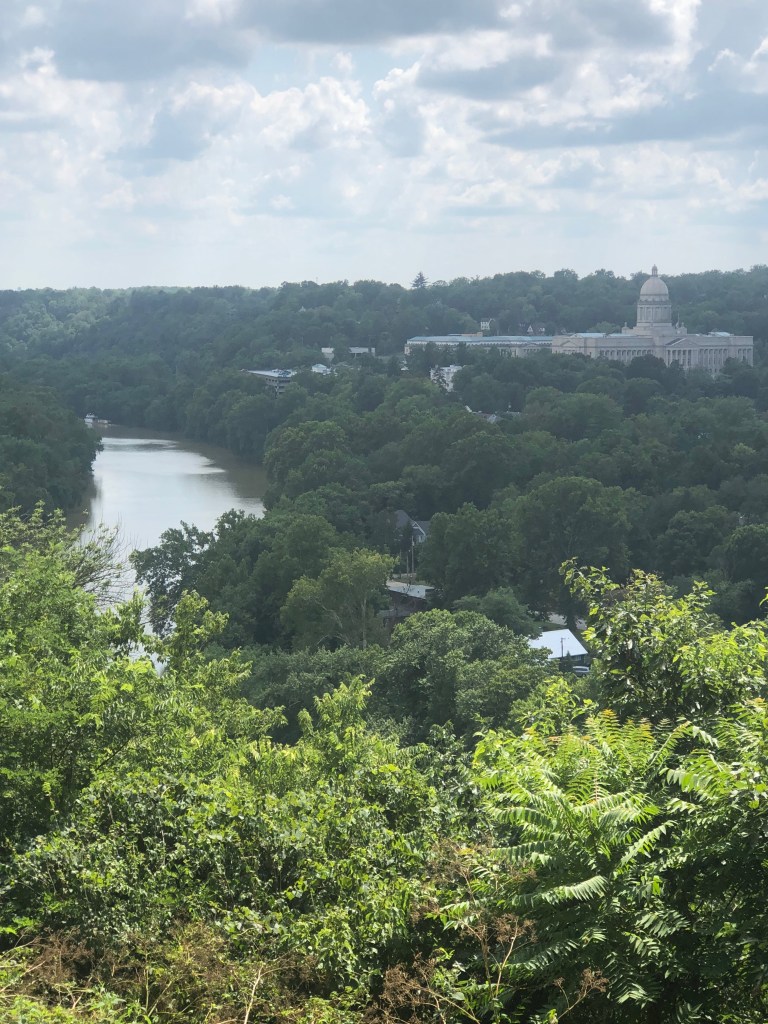

As one stands on the hillside overlooking Frankfort, the view today is unchanged. What has changed is where you are standing. The Frankfort Cemetery, then called Hunter’s Garden was a cemetery of the Rural Cemetery Movement sweeping the nation during the 1840s. Judge Mason Brown was inspired by a visit to Mount Auburn Cemetery in Boston, and convinced the civic leaders of Frankfort to incorporate in 1844. Trailblazer, Daniel Boone (1734-1820) lived his final years in St. Charles and Warren County, Missouri. Originally buried on another hillside overlooking the Missouri River, near Marthasville, Missouri and next to his wife Rebecca, his body was said to be disinterred, and reburied at Frankfort, Kentucky in 1845. Historians still debate the removal to this day.

Thousands would migrate from Virginia, and Kentucky, when the War of 1812, often referred to as the second Revolutionary War, ended. Many of these were families whose fathers and grandfathers had fought in the Revolutionary War, and whose land in Kentucky were Land Warrants for their service in that war. With the close of hostilities, and the signing of the Treaties of Peace and Friendship with the Osage and other tribes on September 15, 1815, the settlers felt safe. Many of those families had come with the Boones, and their numerous relatives as early as September of 1799, and fought what they referred to as “the Indian Wars” here on the frontier. Including Missouri’s Territorial Governor, who had called upon Daniel’s sons, Nathan and Daniel Morgan, to muster troops before Congress even officially declared war.
By the time of Missouri’s Statehood in 1821, the land that was once the Louisiana Purchase, had seen these families establish themselves firmly in Missouri, with their enslaved. Though Missouri’s birth had been difficult because of the issue of slavery, those living here at that time firmly believed in the institution. The Boone family, and their families like the Callaways, had brought many enslaved with them. They were even the prime source of free labor that were used in the commercial endeavors as far west as the Booneslick, where the town of Franklin lay, which is also known as the the beginning of the Sante Fe Trail. This was the site of one of the largest commercial salt works. The Booneslick Road which led from St. Charles to Franklin was used as the primary course for travel westward which led from County Seat to County Seat, just as Campbell shares in his journal. Americans were using roads to migrate, like the map shows, sometimes forsaking the rivers that had been the major source for transportation for the past century.
And while these families in this caravan would ultimately settle, live and die together in the Dardenne community, so too would their enslaved. James H. Alexander’s wife had inherited an enslaved female named Louisa. Louisa would become the wife of Archer Alexander, even though the practice of marriage was not allowed to the enslaved. Marriage among the enslaved was a cultural practice, recorded only in oral traditions, that simply meant that the couple had “jumped the broom” to signify their commitment. Often couples did not even live together, and children born as a result were owned by the mother’s owner. Louisa is documented in the inventory of the Alexander estate, with her seven children. One of which is James, thought to be Archer Alexander’s son. James Alexander is buried next to her in the Grant Chapel A.M.E. Cemetery., in nearby Wentzville, Missouri. Perhaps Caroline was enslaved by the Callaways, who were part of Daniel Boone’s family.
Archer Alexander was buried at St. Peters Cemetery [http://stp-cemetery.org/] in St. Louis in a common lot on December 8, 1880 at the age of 74. He followed his second wife, Julia, who was also interred there in 1879.
*This is the journal of William Campbell (1805-1849) leading four families from Lexington, in Rockbridge County, Virginia to St. Charles County Missouri, written in 1829. There are 55 people in this caravan, 25 of which are enslaved. Among the enslaved is Archer Alexander.\This journal is located in the collections of the Leyburn Library, Special Collections and Archives, located at the Washington and Lee University, in Lexington, Virginia, and for which we are deeply indebted to Lisa McCown. Editor and author is Dorris Keeven-Franke. The next journal entry is September 21, 1829… https://archeralexander.blog/2023/09/21/entry-26-date-21-september-1829/
TODAY
The home of Nathan Boone, where his father Daniel spent many of his last years, is a few miles to the south of Dardenne, where members of this caravan would settle within just a few weeks. Today the Boone Home is part of St Charles County Parks, and is located in Defiance, When Daniel Boone died September 26, 1820 he was visiting at this home. He was originally buried about 15 miles to the west of Nathan’s home and about 12 miles west of Dardenne, near Marthasville, Missouri.


 ARCHER ALEXANDER
Leave a comment