Next day came through a rough country with a miserable population of the lowest order. Country is limestone. Some stone coal. Water bad from wells. Encamped at Markells, where our best horse died suddenly, the effect of a hard drive, after a hearty dinner of green corn. Hard luck. Roads very hilly.*
The caravan is on the migratory route of buffalo, known as the Buffalo Trace, facing several difficulties now. The roads are bad and rocky, and are thickly wooded. When their best horse dies from eating green corn, William Campbell blames the locals. Things are not going well for Archer and the group that left Lexington, Virginia, back on August 20. William Campbell seems to feel the local population is not the most welcoming he’s encountered either. They are near Portersville, crossing DuBois County in Indiana.
William Campbell was born the 19th of June 1805, one of ten children of Samuel Legrand Campbell and Sally Reid Alexander. His brother Charles Fenelon Campbell had accompanied them until Ripley, Ohio. He had attended what what would become Washington and Lee University where his father was the second President. A recent law graduate, he hoped to establish a lucrative law practice in St. Charles County. Politically, he was a member of the popular Whig Party. Once he reached St. Charles County, he would be elected to serve as a State Representative in 1832 and 1834. He moved to St. Louis where he would also be elected as a State Senator in 1836,’38,’42 and 1846. In 1844, he would become the founder of the Historical and Philosophical Society of Missouri.
When living in Saint Charles, he would be owner/editor of the St. Charles Clarion Newspaper. When he moved to St. Louis he would be owner of the St. Louis New Era Newspaper, where he reported on the issues of slavery. Campbell was a close friend of the abolitionist Elijah Lovejoy, another newspaper editor who would be killed by a mob in Alton, Illinois in 1837. By 1836, Campbell had moved to St. Louis, where he died on December 30, 1849, perhaps a victim of the cholera epidemic that was sweeping the countryside then.
This journal’s author, William Campbell, has known Archer his entire life, because he’s the property of Campbell’s cousin James Alexander. Archer was born in 1806. When James and his wife Nancy (McCluer) Alexander both pass away during the raging cholera epidemic of the 1830s. Alexander’s Will clearly states that Archer is absolutely not to be sold, Archer, his wife Louisa, and their children are only to be rented or used for the financial support and benefit of the four small orphans. William Campbell becomes the executor of the Alexander estate and likewise the person who controls Archer’s life…and freedom.
*This is the journal of William Campbell (1805-1849) leading four families from Lexington, in Rockbridge County, Virginia to St. Charles County Missouri, written in 1829. There are 55 people in this caravan, 25 of which are enslaved. Among the enslaved is Archer Alexander.\This journal is located in the collections of the Leyburn Library, Special Collections and Archives, located at the Washington and Lee University, in Lexington, Virginia, and for which we are deeply indebted to Lisa McCown. Editor and author is Dorris Keeven-Franke. The next journal entry is September 26, 1829 https://archeralexander.blog/2023/09/26/entry-31-date-26-september-1829/
TODAY

Hobard McDonald and Henry Rudolph are pictured with two teams of mules and a large log on a box wagon chassis in Portersville sometime in the early 1900s. The sycamore log was said to be 58 inches in diameter. From the August 21, 2017 issue of the DuBois County Herald.
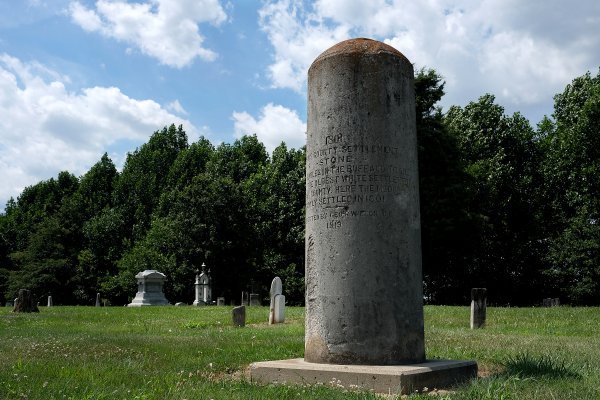
Information and photos are from the DuBois County Herald article by Leann Burke [https://duboiscountyherald.com/b/portersville-history-chronicled-starting-with-settlers]… “The Buffalo Trace was part of a buffalo migratory route that ran through Indiana, Illinois and Kentucky. It served as the first major road into what became Indiana and ran through Dubois County near the White River in present day Boone Township.”
*This is the journal of William Campbell (1805-1849) leading four families from Lexington, in Rockbridge County, Virginia to St. Charles County Missouri, written in 1829. This journal is located in the collections of the Leyburn Library, Special Collections and Archives, located at the Washington and Lee University, in Lexington, Virginia, and for which we are deeply indebted to Lisa McCown. Editor is Dorris Keeven-Franke.

 ARCHER ALEXANDER
Leave a comment