Abraham Lincoln was born on February 12, 1809, and died from an assassin’s bullet on April 15, 1865. While serving as our Nation’s 16th President, his Emancipation Proclamation, officially Proclamation 95, an executive order, stated
“on the first day of January, in the year of our Lord one thousand eight hundred and sixty-three, all persons held as slaves within any State or designated part of a State, the people whereof shall then be in rebellion against the United States, shall be then, thenceforward, and forever free; and the Executive Government of the United States, including the military and naval authority thereof, will recognize and maintain the freedom of such persons, and will do no act or acts to repress such persons, or any of them, in any efforts they may make for their actual freedom.”
When learning of Lincoln’s death, a formerly enslaved woman named Charlotte Scott in Ohio gave her first $5 ever raised in freedom
“to make a monument to Massa Lincoln, the best friend the colored people ever had.” Such a monument would have a history more grand and touching than any of which we have account. “The suggestion was cordially accepted, and a circular letter was published inviting all freedmen to send contributions for the purpose to the Commission in St. Louis”
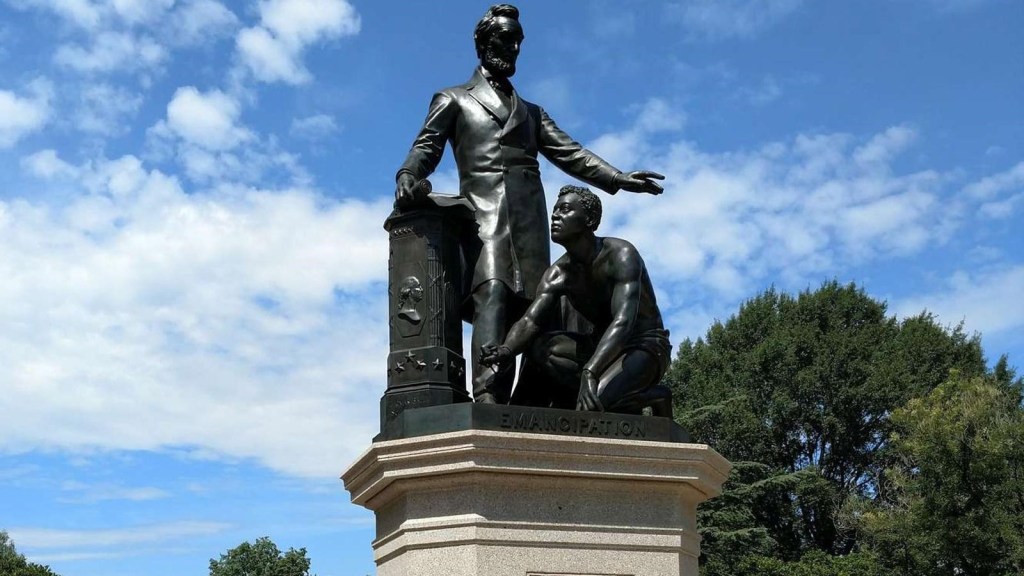
The formerly enslaved, the former U.S. Colored Troops, and freedmen from across the country contributed over $16,000 [approximately $475,000 in 2025] to erect what was originally called Freedom’s Memorial. On April 14, 1876, over 25,000 people would witness the unveiling by President Ulysses S. Grant, followed by a speech from the great orator Frederick Douglass:
Friends and fellow-citizens, the story of our presence here is soon and easily told. We are here in the District of Columbia, here in the city of Washington, the most luminous point of American territory…in a word, we are here to express, as best we may, by appropriate forms and ceremonies, our grateful sense of the vast, high, and preeminent services rendered to ourselves, to our race, to our country, and to the whole world by Abraham Lincoln.
What of the other figure with Lincoln, chosen to portray the enslaved man? He was not present, nor recognized that day by anyone other than James Yeatman, President of the Western Sanitary Commission; a private non-profit that provided medical resources to the Union Army during the Civil War and to the formerly enslaved who fled the south after Lincoln’s Emancipation Proclamation. In February of 1863, another member of the Western Sanitary Commission in St. Louis, Missouri, Rev. William Greenleaf Eliot, had provided refuge to an enslaved man named Archer Alexander after he had fled from his enslaver in St. Charles County Missouri. “He was the last fugitive slave captured under civil law in Missouri.” He had risked his life to provide the Union Troops with information about a plot to destroy a local railroad bridge, thereby saving hundreds of lives. When discovered, he would be forced to run, leaving behind his wife and family. He, and sixteen other freedom seekers, would be caught trying to cross at Howell’s Ferry, with the local slave patrol in hot pursuit.
Escaping once again, he reached safety at Eliot’s home in St. Louis. He was given his freedom in September 1863, through Lincoln’s Second Confiscation Act, for important services to the United States military forces. Little did he know that his image would soon become the public icon and controversial figure chosen to represent Lincoln’s Emancipation Proclamation. In 1869, it would be Eliot who would see that Archer Alexander’s photograph was taken for the sculptor Thomas Ball, by then living in Italy, for what would become known as the Emancipation Monument. The monument to Lincoln, was totally funded by the formerly enslaved, it being the first and only such memorial in our Nation’s Capital that still stands today.
After his death, Lincoln would be brought home to Springfield, Illinois to be interred with great ceremony and honor. Archer Alexander would pass away in 1880 and be buried in an unmarked grave in a Common lot of the St. Peters U.C.C Cemetery in St. Louis. Five years later, shortly before his death, Eliot would pen the famous narrative Archer Alexander: From Slavery to Freedom. While today’s research alerts us to some inconsistencies, if it were not for this small book, we may have never known the story of the enslaved man rising as he sees his future with freedom. His burial site is listed today on the National Underground Railroad Network to Freedom, and there is a movement today for a memorial that shares the story of his life. From the Studio of Abraham Mohler, Archer Alexander will now be seen beckoning to all of the souls buried in the mass grave behind him, as he encourages all to rise up, inspired by the prophecy in Isaiah 65: 21-23. [To make a donation click here.] For more information see https://archeralexander.blog/
 ARCHER ALEXANDER
Leave a comment