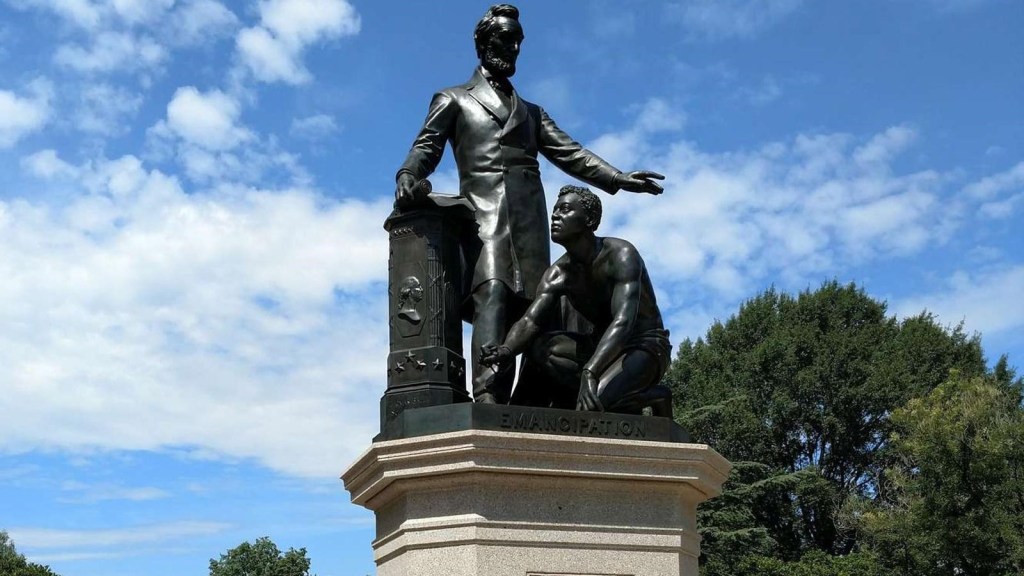
On April 14, 1865, the final shot of the Civil War was fired. Technically, the war had ended a few weeks before with the South’s surrender and all the Generals had laid down their guns. President Abraham Lincoln, the man that had led our nation through one the most trying of times we would ever face lay dead. Felled by a stage actor who had surreptitiously crept up and murdered Lincoln in cold blood by a shot to the back of his head. That shot would reverberate across our entire nation and be felt by every single citizen. No one would be left untouched by that moment in our Nation’s history.
When news reached the state of Ohio, a formerly enslaved woman named Charlotte Scott cried, as she said, “the colored people of America have lost the best friend they ever had”. Heartbroken, she would give her first five dollars she had ever earned in ‘freedom’ for a memorial to her hero. The funds would be held in trust, by the Western Sanitary Commission (WSC), a philanthropic non-profit commission organized in St. Louis, Missouri at the beginning of the war in 1861. The WSC had worked closely with Lincoln and the Union forces, from the war’s very beginning, privately raising hundreds of thousands of dollars through donations, to build hospitals, employ doctors and nurses, and provide for the welfare of all troops. They would provide aid to every Union troop in the Western Theatre.
The WSC had worked for years with all Union troops, they were a trusted and familiar face to the U.S. Colored Troops, freedmen, and fugitives. They had given aid in the form of clothing, food, and other life-saving supplies to the hundreds of Contraband Camps, filled with freedom seekers that had fled the war torn south and border states. It was because of this, that they would be the most trusted entity to assist Charlotte in this one last mission and see it through to completion. They knew the right people, and it wasn’t long before thousands of dollars had been given by the troops, with much of it coming from U.S. Colored Troops stationed in Natchez. They knew Charlotte’s pain, and had donated generously, from their bounties and their paychecks, down to the smallest of all soldiers. More would come from across the country, all from the formerly enslaved, and freedmen that Lincoln had given his life for.
As the years passed, committees were established and there was much discussion as to what this memorial should look like. As times changed with what some called the reconstruction of our country, one man, named Reverend William Greenleaf Eliot, a member of the WSC, did not lose sight of Charlotte’s dream. He’d been born in Boston, and had brought the Unitarian Church to St. Louis in 1834, and would later found Washington University, and had spent his entire life as an abolitionist and in giving aid to others. One of whom was an enslaved man named Archer Alexander.
Archey, as he was sometimes called, had been born in Virginia and brought to Missouri with his wife Louisa, as a young man. There he spent much of the next thirty years living on Dardenne Prairie in St. Charles County just west of St. Louis. Missouri was a border state, so when Lincoln had issued the Emancipation Proclamation for January 1, 1863, it would not affect them. But something else did. He would overhear a group of local Confederates plotting to undermine a local railroad bridge, a vital link for the Union Army. What would you do? If the bridge were to collapse, hundreds of Union troops on board, supplies and payroll would be lost. Archer risked his life to run five miles across the frozen fields in the dark, to warn the Union soldiers stationed at Fort Peruque, guarding the bridge. However, this brave feat would not go unnoticed and soon the local Slave Patrol was out to lynch Archer.
On a cold February night, Archer Alexander and sixteen other men would cross the ice filled Missouri River in a boat stored at Howell’s Ferry by a white abolitionist, making their way for freedom on the Underground Railroad. On the other side of the river, local slave owners had already learned of their brave attempt for freedom and were waiting in ambush. But Archer would escape once again and continue his dangerous journey to the home of Reverend Eliot in St. Louis. Eliot would attempt to purchase Archer from his enslaver Richard Pitman of Cottleville, to be able to give Archer his freedom. Pitman not only refused but used the knowledge of Archer’s whereabouts to try to retrieve what he considered “his property”. After a military commission investigation though, Archer Alexander, was given his freedom, through Lincoln’s Second Confiscation Act of July 1862, on September 24, 1863, for his services to the military. Pitman had been found treasonous to the Union.
After Lincoln’s assassination, the country would mourn his loss. In Boston, a sculptor named Thomas Ball, would feel the nation’s pain. And as all great sculptor’s do, he would use that moment and embrace the pain, and create a work sharing Lincoln’s greatest moment, calling it Emancipation. A few years later, Ball had moved to Florence Italy, when he received a visit from his friend Eliot. Eliot would share Charlotte Scott’s dream for a memorial, but as Eliot explained, the colored people’s funds had only grown to a mere $16,000 (worth about $500,000 today). Ball would give his Lincoln sculpture for that amount, while the WSC would ask for one change. The enslaved man, who had broken his own chains, seen crouched and rising as he gazes at the sight of his newfound freedom, was to be that of Archer Alexander.
Eleven years after that fateful night in 1865, on April 14th, 1876, Washington DC would literally close and parade the streets, as they gathered in Lincoln Park to dedicate the first and only monument in Washington DC made to Lincoln by the formerly enslaved of this country. Speeches were made by a Committee of the nation’s black leaders, including Frederick Douglass. Poems were read and songs were sung. One of Lincoln’s greatest Generals, now President U.S. Grant, would pull the gold cord to unveil the monument for one of our country’s greatest heroes, even by today’s standards.
Archer Alexander would pass away a few years later at the age of 74, in 1880, and be buried in an unmarked common lot grave in St. Peter’s United Church of Christ Cemetery in St. Louis, Missouri. Today, his burial is on of the 800 sites on the National Park Services National Underground Railroad Network to Freedom. Their mission, as established in 1998 by Congress, is to honor the resistance to enslavement through escape and flight and to honor those that helped them. (For more see https://www.nps.gov/subjects/undergroundrailroad/what-is-the-underground-railroad.htm).
Please consider a donation to the Archer Alexander Memorial by Abraham Mohler of the Lucas Schoolhouse, by clicking on this link to the St. Louis Arts Chamber of Commerce https://stlouisartschamberofcommerce.org/archer-alexander-memorial-2/
 ARCHER ALEXANDER
Leave a comment