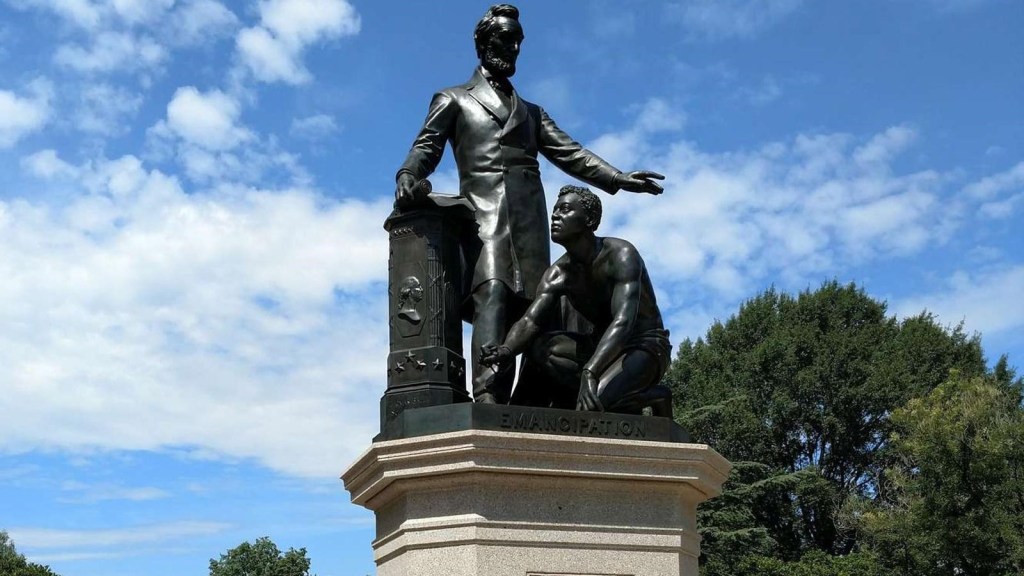

President Abraham Lincoln’s Emancipation Proclamation, issued on September 22, 1862, that became effective on January 1, 1863, declared that all of the enslaved in Confederate-controlled areas were declared free. But the Civil War drug on, and would not end until April 9, 1865, and the Union won. Over 600, 000 lives were lost fighting that war, with thousands also lost by the U.S. Colored Troops. Less than a week after the war had ended, on April 14, 1865, President Abraham Lincoln was assassinated. On that date, a formerly enslaved woman from Marietta, Ohio, named Charlotte Scott, declared that the “colored people had lost the best friend they ever had” and that there should be a monument erected in honor of Lincoln. Scott gave her first $5 ever earned in freedom to that cause, and the funds were held in trust by the Western Sanitary Commission. Thousands of dollars were collected from the formerly enslaved, and the U.S. Colored Troops. All of those funds were raised by the colored people, and used to create that first monument ever erected by the formerly enslaved in Washington, DC. The monument to Lincoln was dedicated on the 11th Anniversary of Lincoln’s assassination in 1876, before 25,000 people, including President U.S. Grant and Fredrick Douglass. That monument, with President Abraham Lincoln, and Archer Alexander, still stands today, in Lincoln Park, a National Park, and is owned by Congress.
The ratification of the 13th Amendment
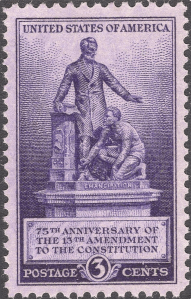
The 13th Amendment is what cemented Lincoln’s Emancipation Proclamation as part of our Constitution. The 13th amendment was passed by the Senate on April 8, 1864, by the House of Representatives on January 31, 1865, and ratified by the required 27 of the then 36 states on December 6, 1865, and proclaimed on December 18, 1865. The Thirteenth Amendment to the United States Constitution abolished slavery and involuntary servitude, except for punishment of a crime. On October 20, 1940, the U.S. Postal Service issued a 3-cent postage stamp with the image of that Monument. The Emancipation Monument served as the primary national memorial to Lincoln in DC until 1922, when the Lincoln Memorial was dedicated in West Potomac Park.”
The Emancipation Memorial in Washington, D.C.
Both the Emancipation Memorial and the U.S. Postal Service Stamp, feature two figures, President Abraham Lincoln and “the last fugitive slave” known as Archer Alexander. Born in 1806 in Virginia, he was taken to Missouri in 1829. He and his wife and children would live enslaved for the next thirty years in St. Charles County, on Dardenne Prairie. In 1863, as Missouri was a slave state, Lincoln’s proclamation did not apply. That winter, Alexander overheard area Confederates plotting to destroy a nearby bridge, and a vital link for the Union Army. He risked his life and rushed to inform the Union Troops and saved the bridge, supplies, payroll, and hundreds of lives. When discovered to be the informant, he fled to St. Louis, with sixteen other men, by the Underground Railroad. He was given his freedom on September 24, 1863 for his actions. He died on December 8, 1880 and is buried in an unmarked grave at St. Peters United Church of Christ in St. Louis at 2101 Lucas and Hunt, which is listed today on the National Underground Railroad Network to Freedom.

ARCHER ALEXANDER
Today Archer Alexander is the only Missouri slave to be known to represent the Emancipation Proclamation on both a Washington DC Memorial and a U.S. Postage Stamp. Now, fundraising efforts are ongoing to raise funds for a new memorial, this time to Archer Alexander, where he has cast off his clothes of enslavement and is beckoning others to follow him to join him in freedom, the same freedom he has seen by Lincoln’s Emancipation Proclamation. Funds are being raised by the St. Louis Arts Chamber of Commerce, and friends and family. Talented sculptor Abraham Mohler has been chosen as the artist. For more about the Archer Alexander see https://archeralexander.blog/, Abraham Mohler or the memorial, or visit https://stlouisartschamberofcommerce.org/archer-alexander-memorial-2/ where one can contribute as well.
 ARCHER ALEXANDER
Leave a comment