
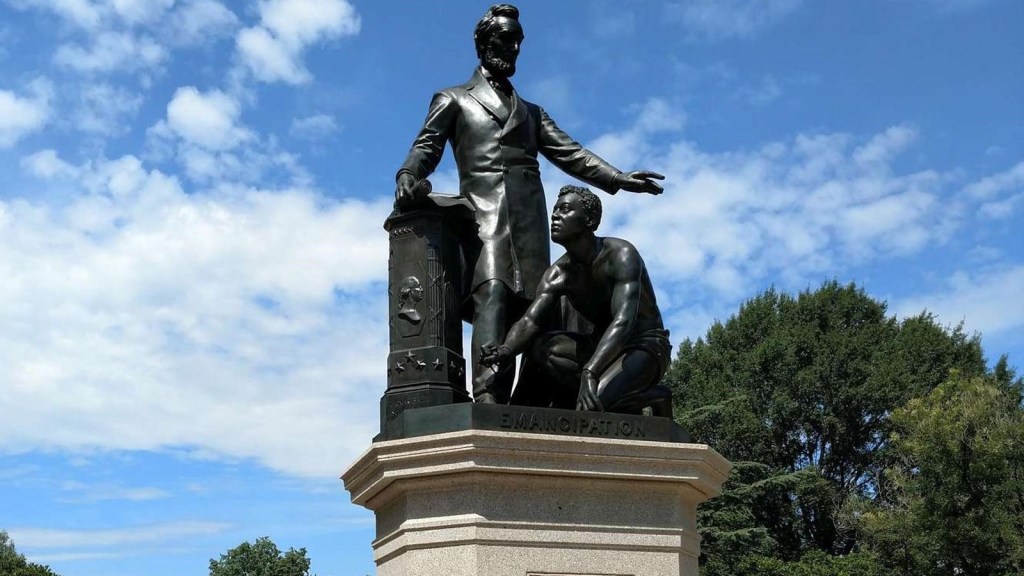
Also known as the Freedom Memorial, the Emancipation Memorial was dedicated by the formerly enslaved as a monument to President Abraham Lincoln, on the 11th Anniversary of his assassination on April 14th, 1876. It was placed in Lincoln Park in Washington, D.C. facing the U.S. Capitol and is on the National Register of Historic Places, and is administered by the National Park Service a Department of the U.S. Interior.
In 1865 with the announcement of the assassination of President Lincoln, a formerly enslaved woman in Marietta, Ohio named Charlotte Scott donated $5 to begin a drive for a memorial to Lincoln. According to John Mercer Langston, she gave those funds to her employer, asking him “to communicate her proposition to some person whose influence and action might result in theaccomplishment of that important design.” [xxiv]

The gift and donation were at once taken to James Yeatman, of the Western Sanitary Commission of St. Louis. This non-profit non-governmental philanthropical organization hadbeen established by Order of Gen. John C. Fremont at the beginning of the Civil War, to providehospitals, nurses, and medical supplies to the Western Army. “Special Orders, No. 159, With a view to the health and comfort of the Volunteer troops in and near to the city of St. Louis, aSanitary Commission is hereby appointed, to consist of five gentlemen, who shall serve voluntarily, and be removable at pleasure. Its general object shall be to carry out, under the properly constituted military authorities, and in compliance with their orders, such sanitary regulations and reforms as the well-being of the soldiers demand.”[xxv]
During the last years of the war, they worked closely with the U.S. Colored Troops to provide supplies to contraband camps and fugitives during the war, in St. Louis, Missouri; Helena, Arkansas; Natchez, Mississippi, and other encampments. Reportedly, it would be the Natchez troops that would donate over $12,000 to the drive. The Western Sanitary Commission’s flyer asked
“We now respectfully ask permission and authority to extend our labors to the suffering freed people of the South-West and South. If you will give us your endorsement in the undertaking before the people, we think we can raise large sums of money, and accomplish great good. Nor would it be only a work of philanthropy, but equally of patriotism, for it would remove an increasing reproach against the Union cause, and by lessening the difficulties of emancipation, would materially aid in crushing the rebellion”[xxvi]
As for the monument itself, it would be William G. Eliot who recalled an old friend now living in Florence, Italy that he decided to visit. There he found a maquette of a piece Ball had done in the heat of the moment following Lincoln’s assassination. Eliot would inform Ball of the drive begun by Charlotte Scott and inform Ball that the amount raised by the freedmen and women to date was about $12,000, to which Ball replied the amount was sufficient. A photograph was taken, and Eliot returned to St. Louis to inform the Commission.

“Bostonian Thomas Ball (1818-1911) started sculpting as a therapeutic means to mend his broken heart after a failed love affair. Early success led him to set sail for Florence in 1854. He returned three years later and began working on what would become his most famous statue, an equestrian George Washington (1869) for the Boston Public Garden. The general, gazing at the horizon, sits erect and controls his animated horse in this work of powerful naturalism. Ball returned to Florence in 1864 and started work on the prototype for the Emancipation Monument that had been commissioned by the Western Sanitary Commission of St. Louis from funds contributed solely by emancipated slaves.
For the final version, erected in 1875 in Lincoln Park on Capitol Hill, Ball had Lincoln freeing a slave whose head was based on Archer Alexander—the last man captured under the Fugitive Slave Law.[xxvii]
Upon his return to St. Louis, the Western Sanitary Commission would request some changes be made. The major change is that of the enslaved man, by removing his soldier’s cap, and the man be the image of someone they all knew, Archer Alexander. A photograph was taken at a local studio in St. Louis and immediately delivered to Ball. Mr. Yeatman wrote Mr. Langston
“By reason of the efficient and liberal management of the commission, the whole sum necessary to provide the work of art suited to the purpose”…” directing him to make full arrangements for the unveiling exercises, the latter did not find it difficult to secure even official and government aid to further in the highest and most important way that purpose.” [xxviii]
While the source of its funding came entirely from formerly enslaved individuals and freedmen, most of the funds came from United States Colored Troops stationed in Natchez, Mississippi.[xxix]
“Ball modeled the head from a photograph that had been sent to him. Americans praised the statue for its authenticity. Ball spent most of his professional life in Italy, but remained true to his native heritage by completing several heroic groups with American themes.”[xxx]
Among those in attendance was Charlotte Scott. Other than Lincoln’s, hers is the only other name on the plaque at the base of the statue:

FREEDOM’S MEMORIAL
IN GRATEFUL MEMORY OF
ABRAHAM LINCOLN
THIS MONUMENT WAS ERECTED
BY THE WESTERN SANITARY COMMISSION
OF SAINT LOUIS MO:
WITH FUNDS CONTRIBUTED SOLELY BY
EMANCIPATED CITIZENS OF THE UNITED STATES
DECLARED FREE BY HIS PROCLAMATION
JANUARY 1 A.D. 1863.
THE FIRST CONTRIBUTION OF FIVE DOLLARS WAS MADE
BY CHARLOTTE SCOTT, A FREEDWOMAN OF VIRGINIA,
BEING HER FIRST EARNINGS IN FREEDOM
AND CONSECRATED
BY HER SUGGESTION AND REQUEST
ON THE DAY SHE HEARD OF PRESIDENT LINCOLN’S DEATH
TO BUILD A MONUMENT TO HIS MEMORY.”[xxxi]
Langston himself organized and led the dedication of the Memorial on April 14, 1876, however, neither Eliot nor Archer Alexander was present at the event. The great orator and spokesperson Frederick Douglass reminded the attendees that:

We, the colored people, newly emancipated and rejoicing in our blood-bought freedom… have now and here unveiled, set apart, and dedicated a monument of enduring granite and bronze, in every line, feature, and figure of which the men of this generation may read, and those of aftercoming generations may read, something of the exalted character and great works of Abraham Lincoln, the first martyr President of the United States.[xxxii]
Washington, D.C. would literally close for the day’s event so that over 25,000 people could attend. The crowd was filled with those who were formerly enslaved, freedom seekers, and former Union troops. It would be the first such monument to ever be funded entirely by the formerly enslaved to honor their fallen friend, President Abraham Lincoln. The National Park Services website states
“The Emancipation Monument served as the primary national memorial to Lincoln until 1922, when the Lincoln Memorial was dedicated in West Potomac Park. Sculptor Thomas Ball depicted a life-size figure of Abraham Lincoln, extending one hand over a kneeling African American man while holding a copy of the Emancipation Proclamation in the other hand. The former slave is depicted as rising, with broken shackles on his wrists. The figure was modeled after Archer Alexander, the last Missouri enslaved man captured under the Fugitive Slave Law.”[xxxiii]
ENDNOTES
[xxiv] Langston, John Mercer, “From the Virginia Plantation to the National Capital”
[xxv] Report of the Western Sanitary Commission for the Year ending 1863”
[xxvi] Western Sanitary Commission, Letter to the President of the United States
[xxvii] Barsoum, Eve L., “Memorials in Washington, D.C.” National Register of Historic Places
Multiple Properties Documentation Form
[xxviii] Langston, John Mercer, “From the Virginia Plantation to the National Capital”
[xxix] Fountain, Deborah, “The Civil War and Natchez U,S. Colored Troops
[xxx] Barsoum, Eve L., “Memorials in Washington, D.C.” National Register of Historic Places
Multiple Properties Documentation Form
[xxxi] Huiner, Marjorie, “Freedwoman of Virginia: Charlotte Scott and the Scott and Rucker
Families of Lynchburg”
[xxxii] Douglass, Frederick, Speech at the Dedication of the Emancipation Memorial
[xxxiii] National Park Service “ Emancipation Memorial” URL Captured June 30, 2023
 ARCHER ALEXANDER