
In 1834, William Greenleaf Eliot (1811-1887) moved to St. Louis from Boston, where he had been born in 1811. He had brought the Unitarian Church to St. Louis, Missouri in 1836 with the founding of the Church of the Messiah on Lucas Avenue. As the founder of the Public School system in St. Louis in 1849, Washington University*, and the Western Sanitary Commission, he was known for his views of what was referred to at that time as “gradual emancipation”which he felt would be achieved because of the huge wave of German immigrants coming to the U.S. at that time. In the 1840s, in order to keep his personal views from the Congregation, he would write under the pen name “Crises” on the difficult subject of slavery.
His home Beaumont was close enough to Camp Jackson that on the day of the event he said ““When broken up by General Lyon and the Home Guards, the rifle bullets came close to our fences”. And when the 6,000 German troops involved (the majority) with the Camp Jackson affair happened he would also write “Missouri was saved to the Union by taking Camp Jackson and the scattering of the disloyal legislature three days before an ordinance of secession would have been passed.”
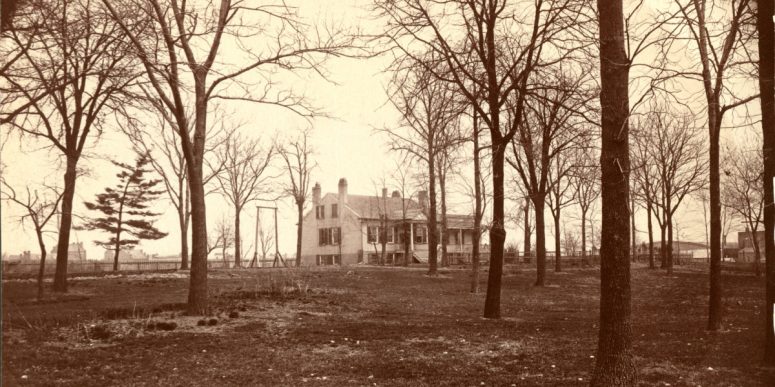
Within two years, he would take in a Fugitive Slave from St. Charles County, and under that law, could have been jailed himself. However, he would instead assist that slave in achieving that freedom, an act that he said President Lincoln himself helped in. In February of 1863, William Greenleaf Eliot gave refuge to the fugitive slave named Archer Alexander in his home. He immediately contacted the U.S. Provost Marshall located in St. Louis, and was given a temporary Order of Protection. He contacted Archer Alexander’s enslaver, Richard Hickman Pitman of Cottleville, using Barton Bates, a Missouri Supreme Court Judge, saying “He promised to write to him at once, and give him my message; viz., that Archer was at my place, and that I was willing to pay his full “market value” for sake of setting him free.” (1) After Archer was attacked and kidnapped by Pitman, Eliot rescued him from his imprisonment in the City Jail. The Order of Protection was made permanent, and after a military trial of Pitman, the fugitive was emancipated.
Later, Eliot would work to see that Archer Alexander was immortalized when he was the face of freedom on the Emancipation Memorial in Washington, D.C. But that would not suffice for telling Archer’s story, Eliot felt and in his last years he would pen “The Story of Archer Alexander” so that all would know the story.
Eliot’s work with the Western Sanitary Commission during the Civil War, with his close friend James Yeatman, would be the backbone for the Union Army west of the Allegheny mountains. They were the network of supplies for the military hospitals and prisons, refugees and soldiers homes. They were also key for the Freedmans Bureau, opened Freedman Schools with an important headquarters at what was called Camp Ethiopia in Helena, Arkansas. And then they opened a Colored Orphans home in St. Louis, in December of 1863. They were the first in the country to give aid to colored schools establishing a High School for African Americans in 1864 in St. Louis.
(1) The Story of Archer Alexander From Slavery to Freedom March 30, 1863 by William G. Eliot, Boston, Cupples Upham and Co. 1885
Washington University today
*The WashU & Slavery Project began in Fall 2020 when the Center for the Study of Race, Ethnicity & Equity (CRE2) convened a working group to explore participation in Universities Studying Slavery (USS). This group began exploring relationships between slavery, its legacies, and our institutional history, and several courses that year engaged students in related research, including a review of USS projects at other universities. A proposed initial phase of the WashU & Slavery Project was enthusiastically supported by Chancellor Andrew Martin and Provost Beverly Wendland, and WashU formally joined Universities Studying Slavery at the end of Spring 2021. See https://slavery.wustl.edu/


 ARCHER ALEXANDER
Leave a reply to Happy Birthday President Lincoln – ARCHER ALEXANDER Cancel reply