
Hard rain in the morning. Very wet. Proceeded to Flemingsburg, a flourishing town of about 1,000 persons. It has a large proportion of well built brick houses. Saw a cotton factory, on a small scale. Encamped at Sulphur Spring one mile from Flemingsburg.*
Campbell is moving slowly now, heading towards Lexington, Kentucky. The heavy rain is making travel difficult. They stopped at the Courthouse in Flemingsburg, The town was founded in 1797 by George S. Stockton, a fellow native of Virginia. Stockton named the town and county after his half-brother Colonel John Fleming. It has been the seat of Fleming County since its formation and was formally incorporated in 1812. It is south of Maysville and northeast of Paris. They moved on to the resort town of Sulphur Springs, which is in Ohio County, Kentucky.
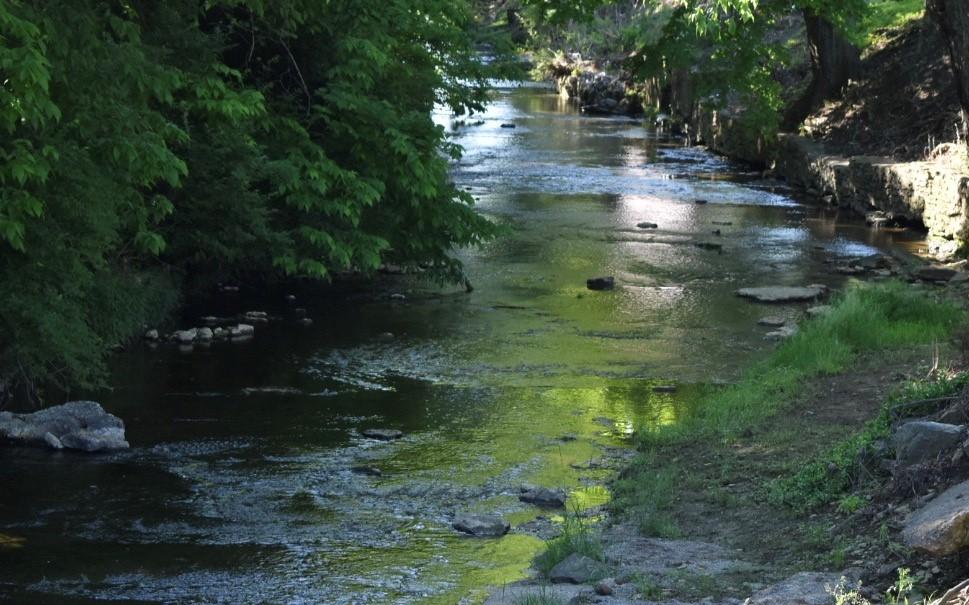
Our journal’s author may have had relatives to visit at Sulpher Springs as well. In 1829, there was another living in Sulpher Springs by the name of William Campbell, a 76-year old pensioner who had served in Lea’s Legion in the Revolutionary War. There are also Howell, Johnsons, and Calloway families here, which are also friends and neighbors in St. Charles, County, which is their destination. It is a resort town, named for its famous spring, reputed to have the gift for healing people.
The enslaved population of Kentucky amounted to 24% in 1830. As a border state positioned between free states to the north and fellow slave owning states to the south, with both independent, hardscrabble white farming families as well as plantations like those of the deep south, Kentucky had economic ties to both slavery, engagement with northern free state industrialism and also western frontier ethos. Like Missouri, Kentucky entered the Union as a state deeply divided over the issue of slavery. The conflicting pulls of northern economic relations, westward expansion, and fundamental support for slavery and southern-style plantations caused Kentuckians to be morally divided over the issue of slavery before, during, and immediately after the Civil War. Though loyal to the Union during the Civil War, the majority of Kentucky didn’t see a profound need to end slavery.
*This is the journal of William Campbell (1805-1849) leading four families from Lexington, in Rockbridge County, Virginia to St. Charles County Missouri, written in 1829. Among the enslaved is Archer Alexander, born in 1806. This journal is located in the collections of the Leyburn Library, Special Collections and Archives, located at the Washington and Lee University, in Lexington, Virginia, and for which we are deeply indebted to Lisa McCown. Editor and author is Dorris Keeven-Franke. The next journal entry is September 16…https://archeralexander.blog/2023/09/17/16-september-1829/
Today
In that era of primitive transportation, the Allegheny Mountains posed the greatest barrier to westward expansion. The two principal routes were overland from Baltimore to Redstone on the Monongahela River via the National Road; or by the Forbes Road from Philadelphia to Pittsburgh. At the end of these two overland treks, the settlers bought or constructed boats and rafts and continued their journey by water.
The flatboat was the cheapest of the many types of boats used and became the standard conveyance for families moving west. All of the boats in this period were hand-powered, with poles or oars for steering, and usually floated with the current. They were not intended for round trips since the settlers used them only to get to their new homes and then broken them up for their lumber.
This situation changed dramatically in 1811 with the launching of the first steamboat on the western waters, the New Orleans, which was built near Pittsburgh. Steamboats made it possible to increase the speed of the trip downriver and made the return trip easier. Commerce on the rivers increased and by the end of 1835 more than 650 steamboats had been built in the west, including 304 in the vicinity of Pittsburgh.
However, the conditions of the rivers made navigation difficult. Shifting sand bars, snags and rocks combined with seasonally fluctuating river depths made river travel dangerous. Mark Twain has immortalized the era of the river pilots who were required to memorize every foot of the river in order to steer the steamboats safely through the many hazards. Even so, boats were wrecked and the increasing amount of trade on the rivers made navigating safely on them of primary importance. River users demanded the federal government step in and improve the rivers.
The first steps were taken in 1824, with an act of Congress authorizing the removal of snags and sandbars from the Mississippi and Ohio rivers. The U.S. Army Corps of Engineers was put in charge of this work.
In the year following, hazards were removed from the river and travel became safer, but the problem of low water remained. State and local governments and private companies attempted to solve this problem but they lacked the resources or the jurisdiction to undertake the massive project.(1)
(1) The above was taken from a great blog about the history of this area http://ohiocountykentuckyhistory.blogspot.com/

 ARCHER ALEXANDER
Leave a reply to 14 September 1829 – Nineteenth Entry – ArcherAlexander.blog Cancel reply