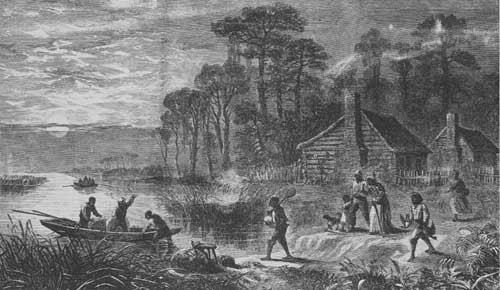
The discovery that Archer Alexander had been the informant who had passed information to the Union Troops about the Confederate’s plans, sent the whole area around Dardenne Prairie into turmoil! While the trains were halted, and the bridge repaired, everyone from Flint Hill to Naylor’s Store to Cottleville was looking for Pitman’s enslaved man. The Union troops at Fort Peruque had received orders from their superiors, that any blacks that were near the Fort were not be given protection but returned to their owners. This Order would go missing. It was a bleak frigid February day, and Archer didn’t know which way to turn next. Someone had told him to avoid St. Charles, as they would certainly be watching for him there. He headed south, towards Howell’s Ferry, falling in with sixteen others also heading in that direction. The Slave Patrol was searching for them, and they would cross the river during the brutally cold night about three in the morning, in a large skiff that a local German stored nearby. Only a sliver of moon lit their way past chunks of floating ice, as they slowly made their way to the south side. Thinking they were successful they were surprised when they suddenly found themselves surrounded by men on horses!
All were captured, and one of them would try to escape. They were chained and taken to a nearby tavern, where their captors were anxious to celebrate. A large bounty was certainly promised for this large group. One of the men in the patrol took off to alert their owners Richard Pitman, Barton Bates, Sam McCluer, and others, all of whom would be pronounced by the local papers as good upstanding citizens. While the captors, a group of area men who had been told to be on the lookout, celebrated their good luck; those captured were stashed upstairs, given bread and bacon, to sit and await their fated destiny. Archer had been unable to sleep. Determined not to let his path to freedom be blocked, he took a bold action and managed to escape once again. He would slowly make his to St. Louis by sleeping during the day, and traveling at night, until he reached the outskirts of the city. In about two weeks, he arrived at his destination, the backdoor of a German meat butcher, where he knew it was safe. When Archer was asked if he was a runaway, he quickly answered “yes”. Archer Alexander would be the “last fugitive slave” captured in Missouri, according to his biographer William Greenleaf Eliot.
In Eliot’s book, Acher Alexander – From Slavery to Freedom, recent research has uncovered some inconsistencies. Archer was born in 1806, enslaved in the Alexander household in Rockbridge County Virginia. Brought to St. Charles County in Missouri in 1829, he and his wife Louisa would have ten children, before that fateful night in February 1863. Archer Alexander is the American Icon for Emancipation, as seen on the Emancipation Memorial in Washington, D.C. He died in December 1880 and was buried in an unmarked grave in St. Peter’s UCC Cemetery (Lucas & Hunt) in St. Louis, Missouri. His burial is listed on the National Underground Railroad Network to Freedom, and more stories like this can be found on my website DorrisKeevenFranke.com
 ARCHER ALEXANDER
Leave a comment