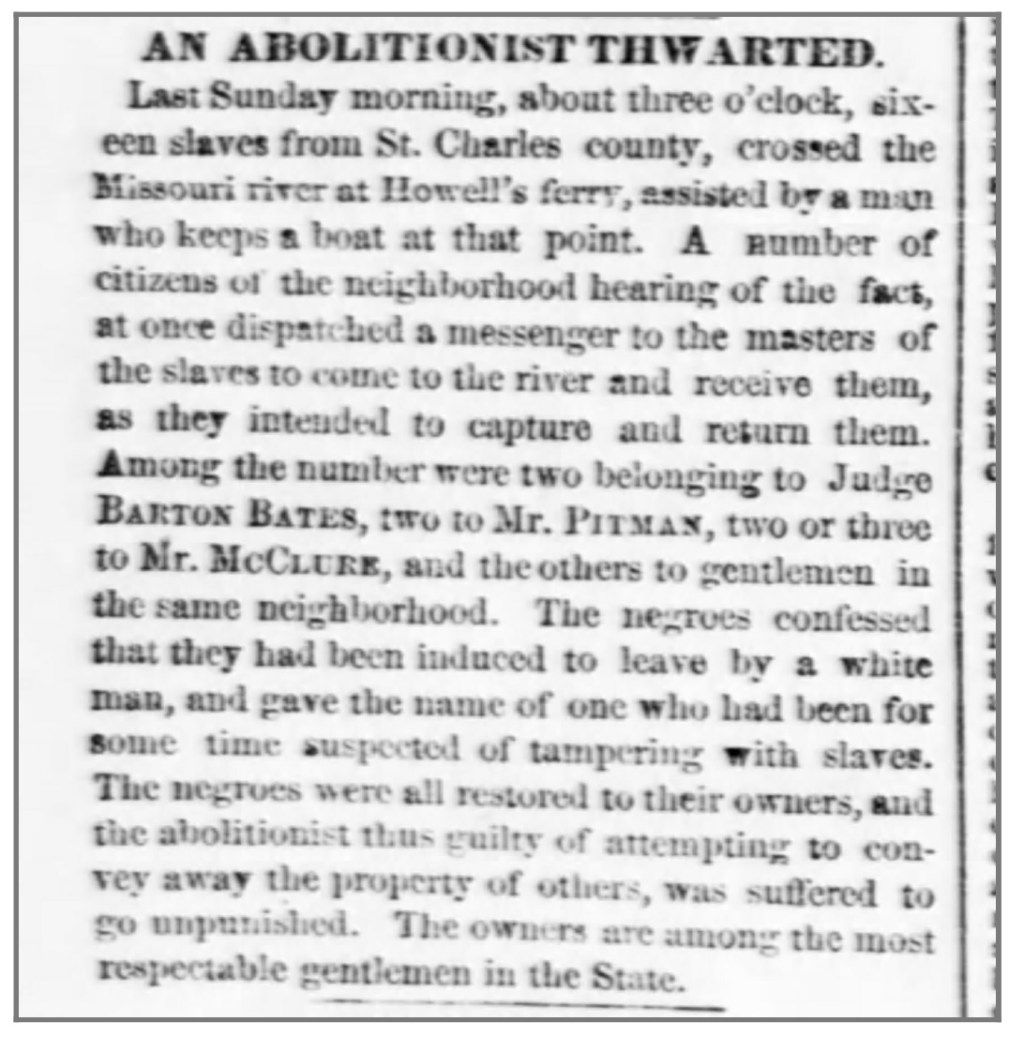
In February of 1863, on a frigid Sunday morning at 3:00 am, sixteen men attempted to make their way across an ice-blocked Missouri River in search of freedom. A local abolitionist, a German immigrant, had stowed a boat near the local ferry crossing, named Howell’s Ferry, for them to use. A few weeks before, one of the enslaved had overheard the local secesh discussing their plans for an attack on the local railroad bridge. Archer Alexander had immediately informed a Captain at Fort Peruque of what he had heard on a cold January night. The North Missouri Railroad wooden trestle bridge crossed a deep ravine, where the Peruque River ran. The railroad served as a vital link for the Union Army in Missouri, where supplies, funds, and troops were sent westward out of St. Louis and St. Charles. Built by the local Home Guards, they also guarded the tracks, which were often under siege by the Confederates that lived nearby.
When the Union discovered the validity of the report, by confiscating the arms and ammunition the Confederates had stored in Captain Campbell’s icehouse, the community was in an uproar! Who was the informant? The local southern sympathizers were anxious to find the informant, and they wouldn’t stop until they had. They had beaten to death an enslaved man just the week before, and the local committee was visiting each plantation’s enslaved in search of the informant. Archer Alexander and the others had just heard they were heading in his direction. No one was safe anymore.
Archer Alexander fell in with sixteen other men, all from Dardenne, in hopes of escaping before the committee arrived. It was a cold, moonless night, and they were desperate. They had crossed the Missouri River and arrived on the south side, where the road rises up to the old Olive Plank Road. No longer a plank road, it still served as a farm-to-market route to St Louis. While well-traveled, as it took only a day’s ride to cover those twenty miles to the St. Louis market and wharves, for a man on foot, avoiding being seen, it took much longer. By mid-day they had made their way a distance of at least five miles and were looking for refuge and a spot to stop and rest.
Suddenly, they were spotted by the local Slave Patrol, a local band of law-abiding vigilantes that were paid to find and retrieve those who had fled their enslavers. These freedom seekers were tied and shackled and returned to the old inn at the landing to await their enslavers. There they were locked overnight in an upstairs room to await the sunrise and their certain fate. Any man being returned would certainly be punished. Archer Alexander was one of the two who had escaped from the Pitman farm, but the only one to escape the inn that night. He had made his way out of a second-story window and managed to escape despite the alarm raised by a guard dog stationed beneath the window. He quickly made his way to the marshes along the river, waiting and watching in the frigid water, as the real traitors arrived to collect “their property.”
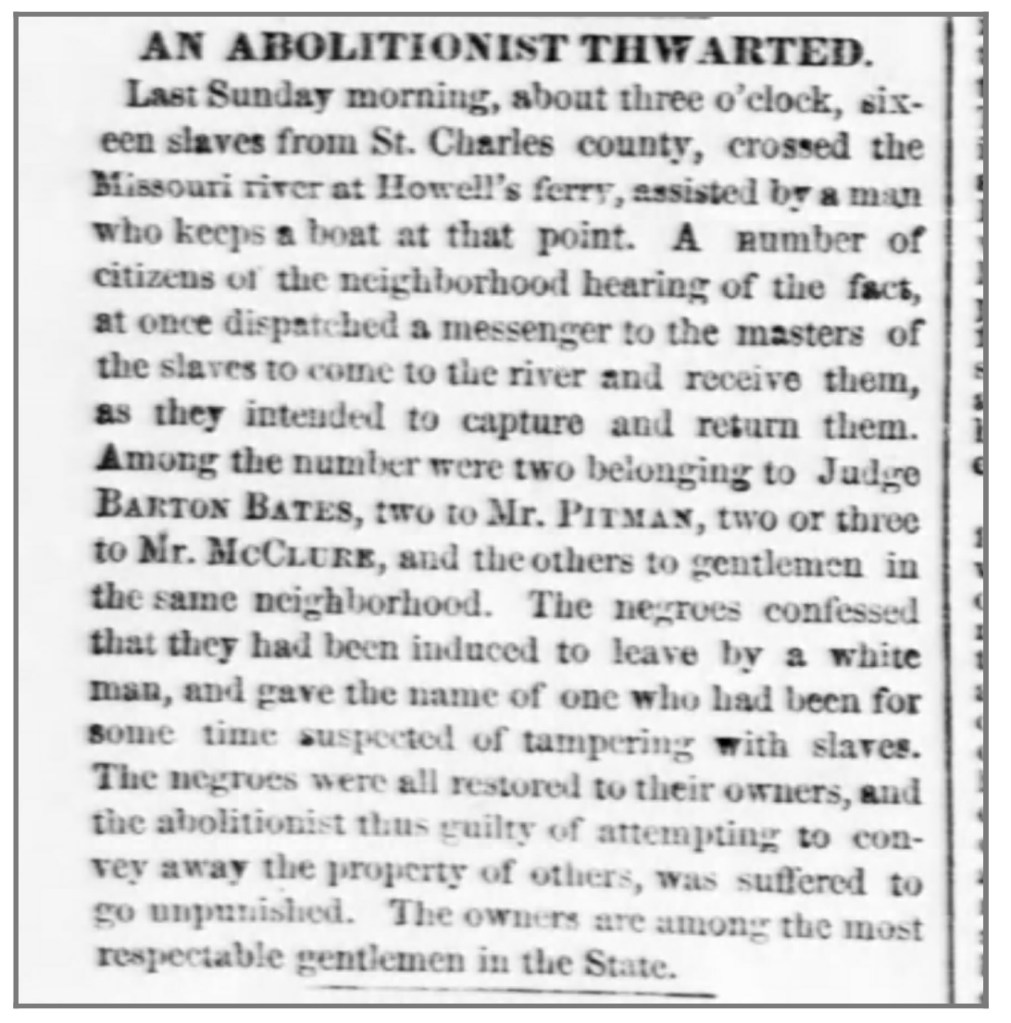
On January 22, 2026, the Missouri River Freedom Crossing was added to the 844+ listed sites on the National Underground Railroad Network to Freedom. The program is a catalyst for innovation, partnerships, and scholarship connecting the legacy of the Underground Railroad across boundaries and generations. The program consists of sites, programs, and facilities with a verifiable connection to the Underground Railroad. There are currently over 800 Network to Freedom locations in 40 states, plus Washington D.C., the U.S. Virgin Islands and Canada. In 1998, legislation titled the National Underground Railroad Network to Freedom Act of 1998 was passed, creating the Network to Freedom program. This program honors, preserves and promotes the history of resistance to enslavement through escape and flight, which continues to inspire people worldwide. Through its mission, the Network to Freedom helps to advance the idea that all human beings embrace the right to self-determination and freedom from oppression. The site was listed by the City of Wildwood, in St. Louis County, Missouri.

 ARCHER ALEXANDER
Leave a comment