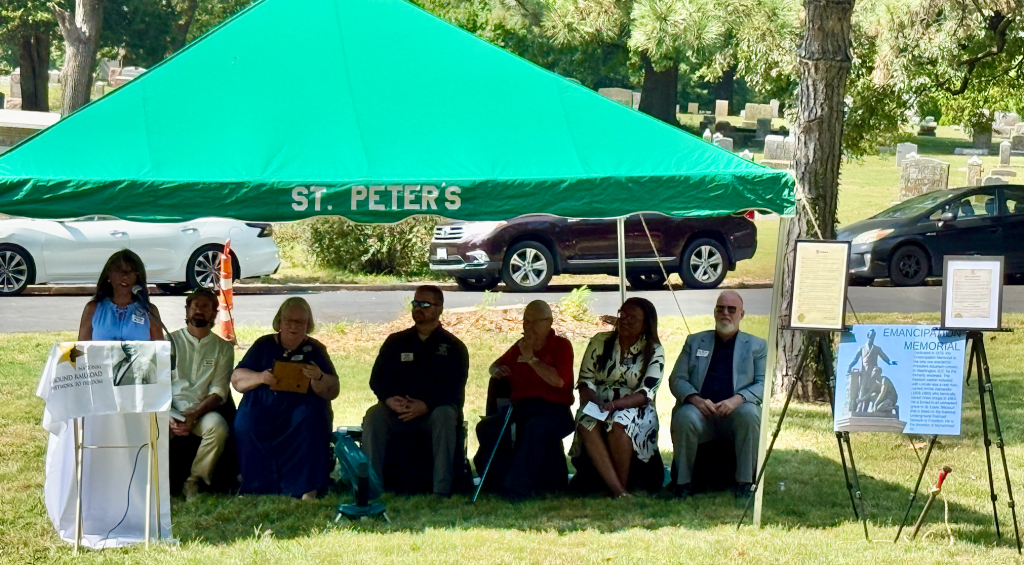
On September 24, 1863, St. Louis newspapers announced that the formerly enslaved man Archer Alexander was free. The Last Fugitive Slave was given his freedom by President Abraham Lincoln and the Union Army for his services to the Military. Earlier that same year, he had reported to Union troops stationed at Fort Peruque in St. Charles County that the Confederates were planning on destroying the vital North Missouri Railroad bridge. He had overheard their plans at a meeting of the local Confederates in the back room of Naylor’s Store, the same property where Archer Alexander’s wife Louisa lived and where the Dardenne Prairie City Hall is located. On Sunday, September 20, 2026, almost one hundred and sixty-three years later, two Missouri cities, Normandy and Dardenne Prairie, would name September 24, 2026, to be Archer Alexander Day.
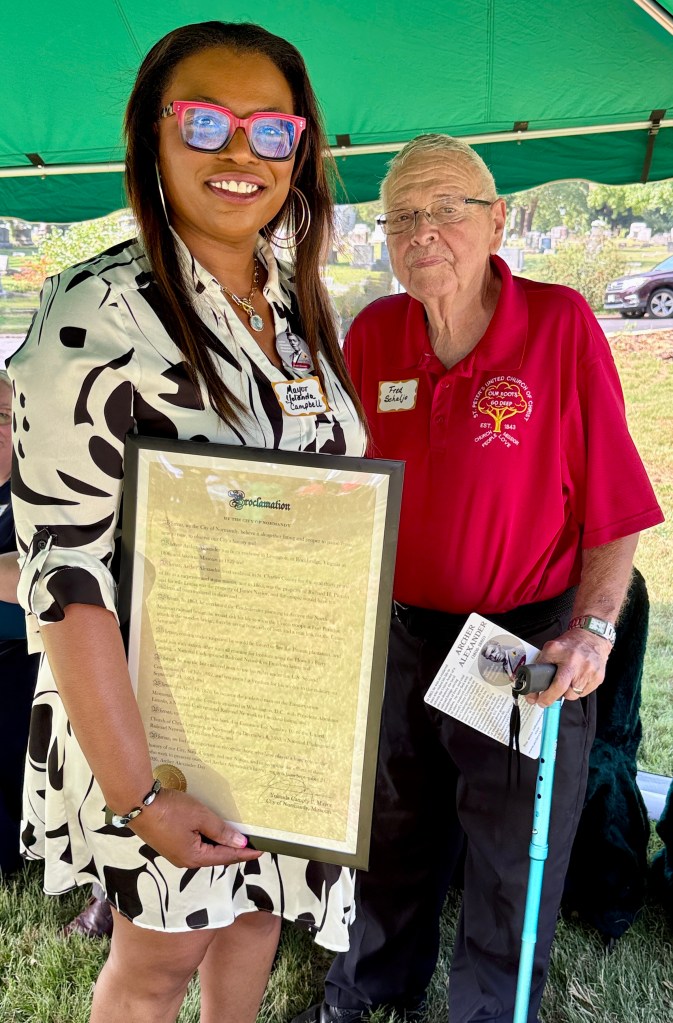
Archer Alexander died in 1880 and is buried in an unmarked grave at St. Peter’s United Church of Christ Cemetery at 2101 Lucas and Hunt Road in Normandy, a city in St. Louis County, Missouri. Normandy’s Mayor Yolanda Campbell presented Mr. Fred Schaljo, President of the St. Peter’s U.C.C. Cemetery, with the following
PROCLAMATION BY THE CITY OF NORMANDY
WHEREAS, we the City of Normandy, believe it altogether fitting and proper to pause from time to time, to observe our City’s history and
WHEREAS, Archer Alexander was born enslaved in Lexington, in Rockbridge, Virginia in 1806, and taken to Missouri in 1829 and
WHEREAS, Archer Alexander lived enslaved in St. Charles County for the next thirty years of life as a carpenter and stone mason, and in 1863, was the property of Richard H. Pitman and his wife Louisa was the property of James Naylor, and the couple would have ten children all born enslaved to them and
WHEREAS, In 1863, he overheard the Confederates planning to destroy the North Missouri railroad bridge, he would risk his life to warn the Union troops at Fort Peruque guarding the wooden bridge, thereby saving hundreds of lives and a vital link for the Union Army and
WHEREAS, coming under suspicion he would be forced to flee the Pitman plantation, and would join with sixteen other men all running for freedom using the Howell’s Ferry Landing, a National Underground Railroad Network to Freedom listing and
WHEREAS, he was the last enslaved man to use his rights under the U.S. Second Confiscation Act of July 1862, and was given his freedom for his service to the military on September 24, 1863, and
WHEREAS, on April 14, 1876, he became the enslaved man on the Emancipation Memorial, erected by the formerly enslaved in Washington, D.C., with President Abraham Lincoln, a National Underground Railroad Network to Freedom listing, and
WHEREAS, upon his death he was buried in Common Lot Number 10, of the United Church of Christ Cemetery, in Normandy on December 8, 1880, a National Underground Railroad Network to Freedom listing, and
WHEREAS, we feel it is important to recognize those who have played a huge role in the history of our City, State, County, and our Nation, and to recognize the efforts of those who work to preserve ours, and Archer Alexander’s history, we proclaim September 24, 2026, Archer Alexander Day.
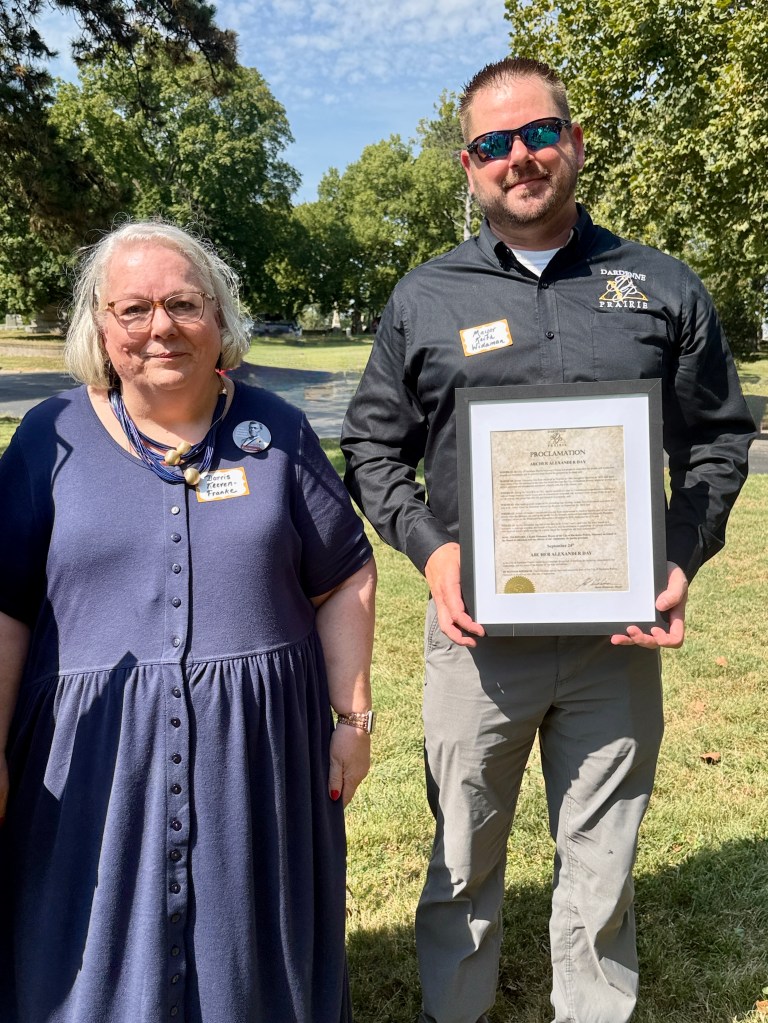
DARDENNE PRAIRIE MISSOURI
Following that presentation, Mayor Keith Widaman presented Dorris Keeven-Franke, President of the Archer Alexander Memorial Foundation, with the following
PROCLAMATION BY THE CITY OF DARDENNE PRAIRIE
WHEREAS, we the City of Dardenne Prairie, believe it altogether fitting and proper to pause from time to time, to observe our City’s history and
WHEREAS, Archer Alexander was born enslaved in Lexington, in Rockbridge, Virginia in 1806, and taken to Missouri in 1829 and
WHEREAS, Archer Alexander would live his life enslaved in what has become the City of Dardenne Prairie, where he worked as a carpenter and stone mason, enslaved by James H. Alexander, who was a member of the Dardenne Presbyterian Church.
WHEREAS, by 1850, Archer’s wife Louisa became the enslaved property of James Naylor, where the couple would have ten children all born enslaved and
WHEREAS, In 1863, while visiting Louisa, he overheard the area’s Confederates planning to destroy the North Missouri railroad bridge, where many of the area’s German men in the Union Army’s Home Guards were stationed, and
WHEREAS, he would risk his and his family’s life to warn those same Union troops at Fort Peruque guarding the vital wooden bridge, thereby saving hundreds of lives and a vital link for the Union Army and
WHEREAS, coming under suspicion he would be forced to flee his enslaver Richard H. Pitman of Cottleville, and would join with sixteen other freedom seekers using the Howell’s Ferry Landing, a National Underground Railroad Network to Freedom listing and
WHEREAS, he was the last enslaved man to use his rights under the U.S. Second Confiscation Act of July 1862, and was given his freedom for his service to the military on September 24, 1863, and
WHEREAS, on this date, we proclaim September 24, 2026, Archer Alexander Day, honoring the man buried in an unmarked grave in St. Louis at St. Peter’s UCC Cemetery, and so honoring all of the African Americans whose resilience to enslavement that he represents today in Washington DC on the National Park Service Emancipation Memorial, erected by the formerly enslaved and dedicated to President Abraham Lincoln on April 14, 1876.
The Archer Alexander Foundation is raising funds for a new memorial by sculptor Abraham Mohler at St. Peter’s U.C.C. Cemetery of Archer Alexander, leading his friends to their newfound freedom. Donations to the memorial can be made at their website https://archeralexander.blog/archer-alexander-memorial-3/


Leave a Reply