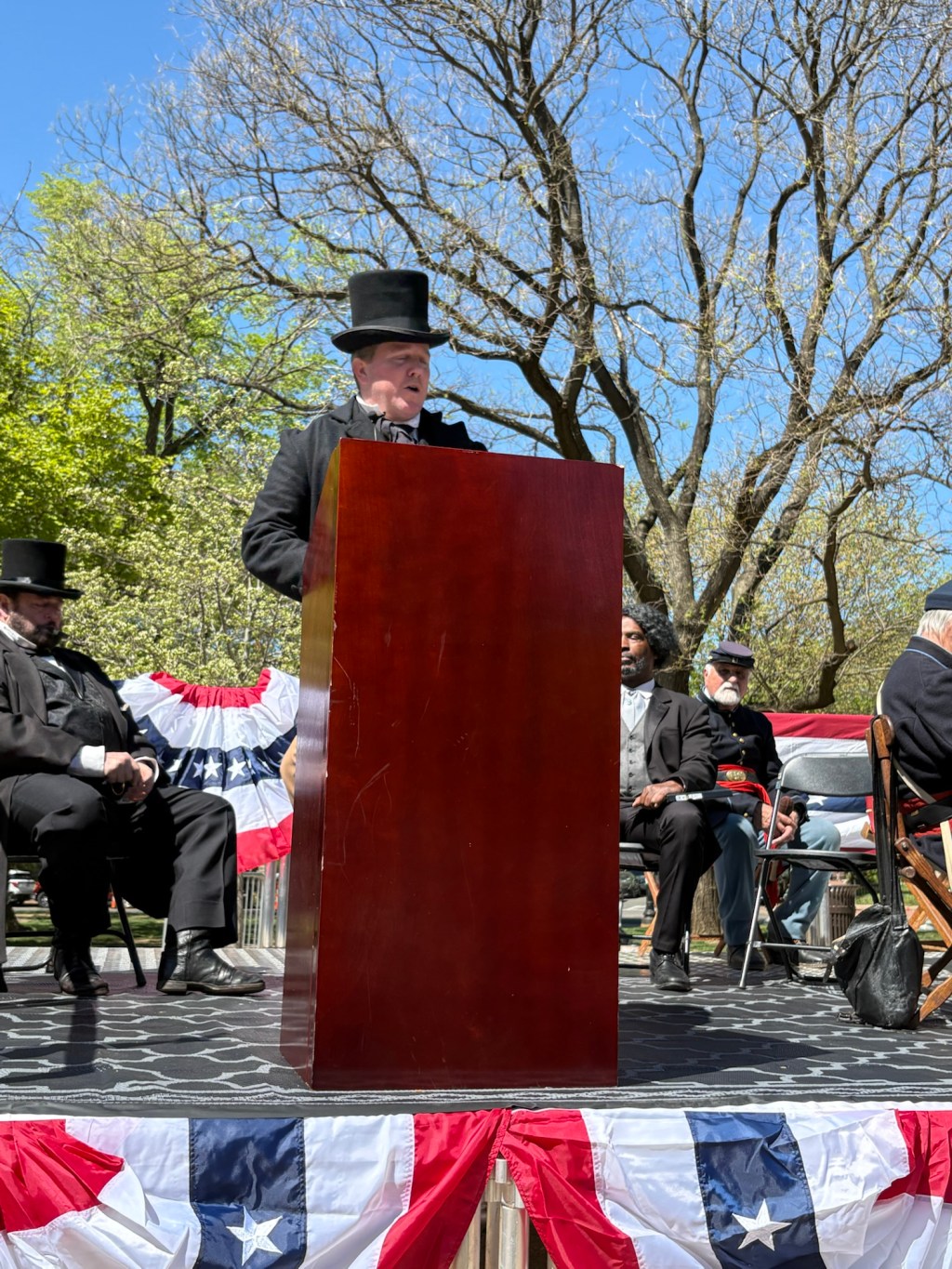
Within days of the end of the Civil War, on April 14, 1865 President Abraham Lincoln was assassinated. When a formerly enslaved woman in Marietta Ohio named Charlotte Scott heard the horrible news she exclaimed “we have lost the best friend the colored people ever had”. She gave the first five dollars she’d earned in freedom to her former master and said she hoped someday that there could be a memorial to President Lincoln. Fundraising would begin and by 1869, the Western Sanitary Commission assisting in the drive had raised over $16,000 with three-fourths coming from the U.S. Colored Troops. All funds had come from the formerly enslaved and freedmen, and on the 11th anniversary, in 1876, the first monument to Lincoln was dedicated. Present that day was Mr. James Yeatman, President of the Western Sanitary Commission, who shared that day the complete story of the Emancipation Memorial.
“The Rev. Wm. G. Eliot, of St. Louis, to whom had been assigned the presentation of the monument for the acceptance and approval of those who had contributed the funds for its erection, and to give a short historical account of the same, has been prevented from doing so, and it has only been within the last few hours that I received notice that he could not be present, and that I was requested to take his place, which I am but poorly qualified to do. Asking your kind and considerate indulgence, I shall proceed to do so, as the representative and president of the Western Sanitary Commission, to whom was entrusted the contributions of freedmen and the expenditure of the same for the erection of the freedmen’s memorial at the national capital.
It is perhaps proper that I should tell you how it was that the [Western] sanitary commission came to be intrusted with this work. This commission, composed of Rev. Wm. G. Eliot, George Partridge. Carlos S. Greeley, Dr. J. B. Johnson and James B. Yeatman, well known Union citizens of St. Louis, were appointed by General John Fremont and afterwards ratified by Secretary Stanton. Their duties principally were to look after the sick, fit up and furnish hospitals, provide competent nurses, &c. But as the war progressed their duties were greatly enlarged. The care of the families and orphans of soldiers, Union refugees, the freedmen; in short, all the humanities growing out of the war came under their charge.For these purposes large sums of money, clothing, &c., were contributed and sent to them, and I can say honestly and judiciously expended. Their total receipts amounted to over four and a quarter million. The whole of which was the spontaneous gift of individuals in all parts of the country, from San Francisco to Maine, and without the aid of a single organized auxiliary association.
And finally, after the war was closed; after the lamented, honored and loved Lincoln had been so brutally assassinated in this city, five dollars was sent to us — the contribution of Charlotte Scott, a poor slave woman, who, on hearing of the assassination of President Lincoln, went in great distress to her mistress — that had been, for she was then free and said to her: “The colored people have lost their best friend on earth . Mr. Lincoln was our best friend and I will give five dollars of my wages towards erecting a monument to his memory. This money; this five dollars; this grain of a mustard seed, contributed by Charlotte Scott in gratitude to her deliverer, was sent to us by her former master, Mr. Wm P. Rucker, through the hands of General T. C. H. Smith, then in command of the military post of St. Louis, having received it from Mr. Rucker, who was a Union refugee, from Virginia, having sought safety for himself and family in Marietta, Ohio, taking along with him Charlotte Scott, and perhaps others belonging to him. It was this five dollars that was the foundation of this beautiful and appropriate memorial which we now see before us. General Smith addressed a letter to me, conveying it, which was as follows;
St. Louis, April, 26, 1865.
James E. Yeatman Esq, :
My Dear Sir : A poor negro woman of Marietta, Ohio, one of those made free by President Lincoln’s proclamation, proposes that a monument to their dead friend be erected by the colored people of the United States. She has handed to a person in Marietta five dollars as her contribution for the purpose. Such a monument would have a history more grand and touching than any of which we have account. Would it not be well to take up this suggestion and make it known to the freedmen?
Yours truly, T. C. Smith.
In compliance with General Smith’s suggestion I published his letter with a card, stating that any desiring to contribute to a fund for such a purpose, that the Western Sanitary Commission would receive the same and see that it was judiciously appropriated as intended. In response to this communication liberal contributions were received from colored soldiers under the command of General J. W. Davidson, headquarters at Natchez, Miss., amounting in all to $12,150. This was subsequently increased from other scources to $16,242. From the liberal contributions made in the first instance, we were led to believe that a very much larger sum would have been donated.
But, as our determination was to have a free will offering without solicitation we determined to rest with what was voluntarily contributed. This prevented the execution of a design made and submitted by Harriet Hosmer,one of America’s most renowned sculptors. The design was one of great beauty and merit, and could it have been executed, it would have been one of the grandest and most beautiful monumental works of art ever erected in this or any other country. I mention this now as the design and its adoption by the commission was generally known, and some explanation for its non-execution may be deemed necessary. It was published in the London Art Journal and other journals in this and other countries.
I trust yet that the gratitude of the freed people will prompt them to execute this grand design I now proceed to give you the history of the Lincoln monument as adopted and executed. One of the members of the Western Sanitary Commission, Rev. Wm. G. Eliot, being in Florence in the autumn of 1869 when visiting the studio of Mr. Thomas Ball saw the group subsequently adopted, and was so much pleased with it that he spoke strongly in its praise after returning to St. Louis. He had learned from Mr.Ball that the work was conceived and executed under the first influence of the news of Mr. Lincoln’s assassination. No order for such a group had been received, but Mr. Ball felt sure that the time would come when there would be a demand for it, and, at any rate, he felt an inward demand to produce it. His aim was to present one single idea representing the great work for the accomplishment of which Abraham Lincoln lived and died ; and all accessory ideas are carefully excluded. Mr. Ball also determined not to part with it, except under such circumstances as to insure its just appreciation, not merely as a work of art but as a labor of love — a tribute to American patriotism. For several years it has stood there in its place, greatly admired, but not finding the direction of its rightful destination.
But, when the artist heard of the possible use to which it might be put as the memorial of freedom by the emancipated slaves themselves, he at once said that he should hold it with that view until the commission were prepared to take action, and that the price to be paid would be altogether a secondary consideration. When the description was given to the other members of the Western Sanitary Commission, they sent for photographs four of which, presenting the group at different points of view, were taken in Florence and forwarded to them. They at once decided to accept the design, and an order was given for its immediate execution in bronze, in accordance with the suggestions made by Mr. Ball.
The original group was in Italian marble, and differs in some respects from the bronze group now to be inaugurated. In the original the kneeling slave is represented as perfectly passive receiving the birth of freedom from the hand of the great liberator. But – the artist justly changed this, to bring the presentation nearer to true historical fact, by making the emancipated slave an instrument in his own deliverance. He is accordingly represented as exerting his own strength with strained muscles in breaking the chain which had bound him. A far greater degree of dignity and vigor, as well as of historical accuracy, is thus imparted. The original was also changed by introducing, instead of an ideal slave, the picture of a living man — the last slave ever taken up in Missouri under the fugitive slave law, and who was rescued from his captors (who had transcended their legal authority) under the orders of the Provost Marshal of St. Louis. His name is Archer Alexander, and his condition of servitude legally continued until the emancipation act became the Law of the land. A photographic picture was sent to Mr. Ball, who has given both the face and manly bearing of the negro. The ideal group is thus converted into the literal truth of history without losing anything of its artistic conception or effect.
The monument, in bronze, now inaugurated was cast at the Royal Foundry, in Munich. An exact copy of the original group as first designed by Mr. Ball, has been executed by him in pure white Italian marble for the Western Sanitary Commission, and will be permanently placed, as Freedom’s Memorial in some public building of St. Louis. Of the eminent sculptor, Thomas Ball, to whose genius and love of country the whole purpose of the work is due, it is unnecessary to speak. His design was accepted, after three years diligent seeking, solely on its merits. But it is a source of congratulation to all lovers of the American Union that this monument, in memory of the people’s President and the freedmen’s best friend, is from the hand of one who not only stands in the foremost rank of living artists, but who is himself proud to be called an American citizen.
The amount paid Mr. Ball for the bronze group was $17,000, every cent of which has been remitted to him. So you have a finished monument, all paid for. The Government appropriated $3,000 for the foundation and pedestal upon which the bronze group stands, making the cost, in all, $20,000. I have thus given you a brief history of the Freedmen’s Memorial Monument, and how and why the Western Sanitary Commission came to have anything to do with it. To them it has been a labor of love. In the execution of the work they have exercised their best judgment — done the best that could be done with the limited means they had to do it with. It remains with you and those who will follow to say how wisely or how well it has been done. Whatever of honor, whatever of glory belongs to this work, should be given to Charlotte Scott, the poor slave woman. Her offering of gratitude and love, like that of the widow’s mite, will be remembered in heaven when the gifts of those rich in this world’s goods shall have passed away and been forgotten.”*
*INAUGURAL CEREMONIES OF THE FREEDMEN’S MEMORIAL MONUMENT TO ABRAHAM LINCOLN, William Greenleaf Eliot Personal Papers, University Archives, Department of Special Collections, Washington University Libraries


